Operations research · Transport · Computational intelligence
Tingting Yang
PhD candidate in Operations Research, expected 2027 Centre for Intelligent Transport, School of Engineering and Materials Science, Queen Mary University of London
I develop optimisation and machine-learning methods for public transport. My PhD models London's full multimodal network from operational data and designs algorithms that find diverse, efficient and less crowded journeys in real time. I also use large language models to turn what travellers say they want into routing objectives.
On the 2026–27 academic job market. I am looking for postdoctoral and lecturer / assistant professor positions in operations research, transportation and computational intelligence.
My PhD addresses the multi-objective shortest path problem, an NP-hard problem in combinatorial optimisation, applied to multimodal public transit routing. I build large-scale transit networks of London from real operational data, and design evolutionary and search-based algorithms, enhanced with machine learning, that plan journeys under dynamic network conditions. I benchmark them against Dijkstra's algorithm, A* and McRAPTOR.
Before the PhD I worked on logistics and supply-chain problems: online 3D pallet loading with deep reinforcement learning, extended reality in IoT-enabled supply chains, and driver stress prediction from physiological signals. Across these projects I aim for methods that are theoretically grounded and can be deployed in real transport systems.
Thesis: Trustable Public Transit through Integrated Multimodal Transit Networks and Trip Planning. Supervised by Dr Jun Chen and Prof. Greg Slabaugh.
Multi-objective optimisation
Public transit routing
Evolutionary computation
LLM agents for transport
Vehicle routing and packing
Logistics and supply chains
ResearchLines of work
ACrowding-aware multimodal routing
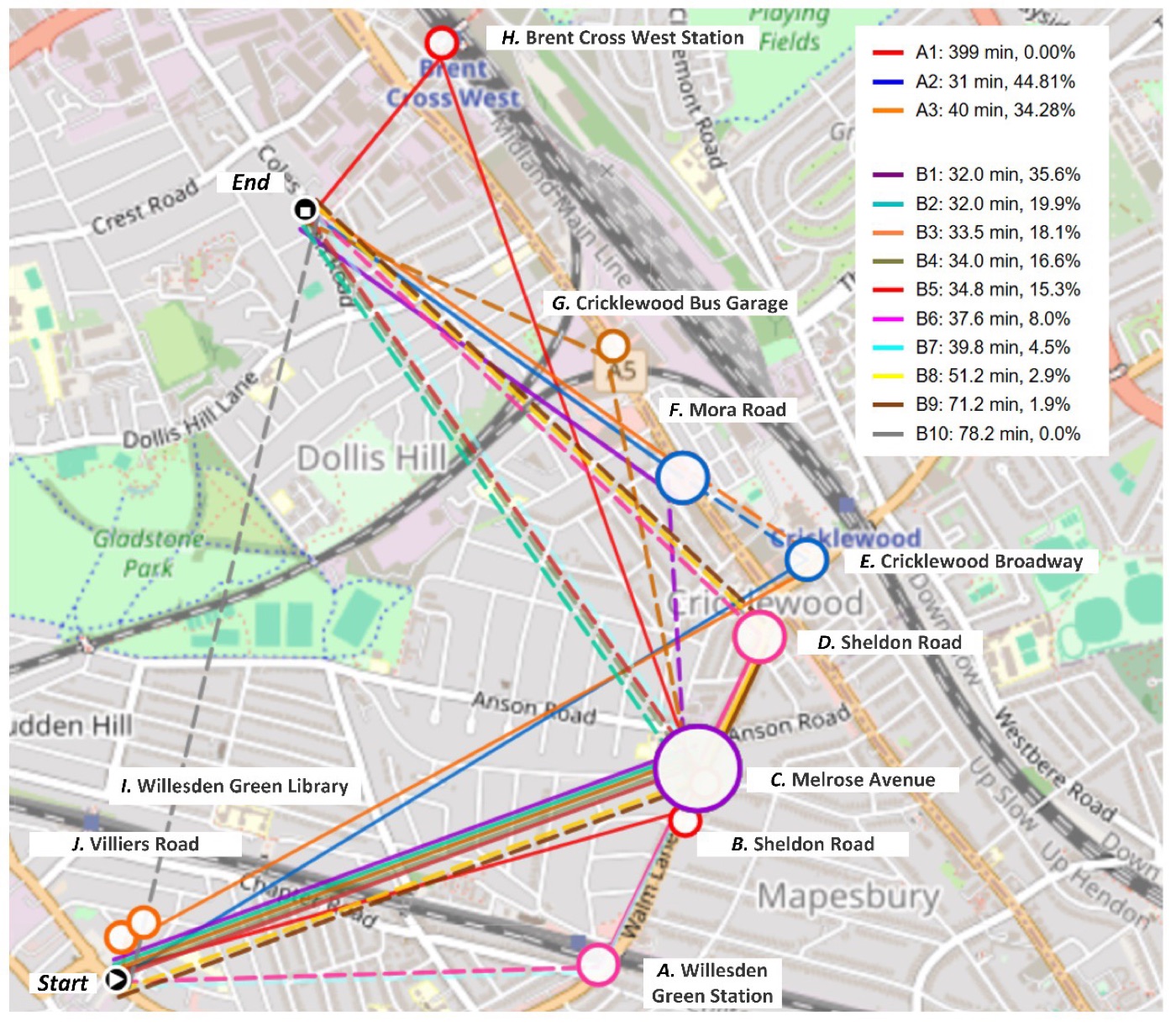
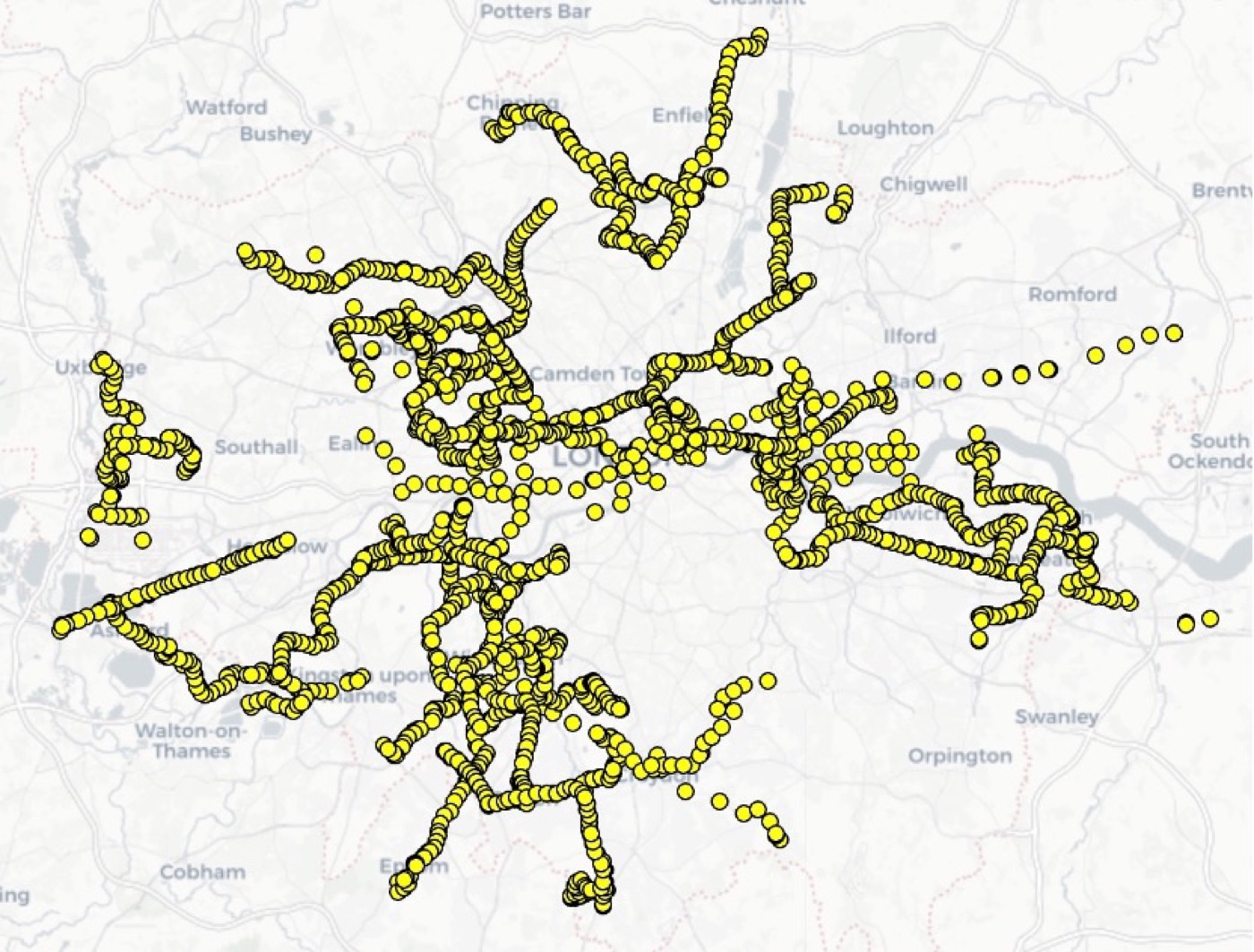
Journey planners rank routes mainly by travel time and treat walking only as a transfer between rides. I built a multigraph of London's public transport from operational data, covering bus, Underground, Overground, DLR, river boat, cable car and walking links between nearby stops, and formulated journey planning as a multi-objective shortest path problem over travel time and crowding.
My evolutionary framework, MOVER, builds on NSGA-II with a priority-value encoding and weight-mapping crossover, so it needs no repair step for invalid paths. Across 30 London test journeys it finds routes that combine walking and transit to reduce crowding without adding travel time. These routes appear when stations are densely spaced, when timetables are sparse, or when the transit path is circuitous. Standard solvers do not return them.
I study why the evolutionary router does well on some journeys and stalls on others by analysing its solutions, its search behaviour and problem-specific features. Machine-learning models trained on these features then decide when and where to apply local search, with the aim of improving solution quality, route diversity and run time.
Related work speeds up and opens up the routing substrate itself. TEEG-INCR performs millisecond-scale incremental updates for earliest-arrival routing at city scale, and a standardised, multi-city, RAPTOR-compatible dataset is designed for evolutionary algorithm research.
IEEE Transactions on Evolutionary Computation (in preparation)Scientific Data (in preparation)TEEG-INCR (in preparation)
CPersonalised routing with LLM agents
Travellers describe what they want in their own words, and those preferences rarely map cleanly onto a routing algorithm. ChatPlanner extracts routing parameters and preferences from natural-language queries using fine-tuned language models (Llama and Qwen, trained with QLoRA) combined with retrieval-augmented generation, then writes them into the objective function of an extended McRAPTOR that scores safety, tourism, comfort and efficiency. A LangGraph agent coordinates the steps.
Example query“Get me to the museum by ten, and I'd rather avoid packed trains.”
Preference-aware datasets built around eight traveller personas and five contexts set the scoring standards for both fine-tuning and retrieval. Fine-tuning enforces the output structure and learns general preference patterns; retrieval resolves vague or conversational wording. Combined, they give the most accurate extraction. Tested on London's network, ChatPlanner reliably returns journeys people can actually take, and surfaces alternatives that existing journey planners overlook.
Online 3D pallet loading. A mixed-reality pallet loading system that places parcels without knowing future orders, combining a maximal-rectangle cutting strategy, a deep Q-network and lookahead. Tested with SF Express, DHL and Royal Mail parcel sizes on ISO pallets.
Extended reality in IoT supply chains. A systematic review that used text mining to select and analyse 71 of 1,207 publications on how XR links people with cyber-physical systems in logistics.
Driver stress prediction. GP-CNN-LSTM, which uses genetic programming to evolve features from physiological signals and predicts driver stress 60 seconds ahead with stable accuracy.
Feature construction with genetic programming. Multi-objective genetic programming that builds features guided by the data manifold, applied to music tagging (with Chenhao Xue).
PublicationsPapers
ACrowding-aware routingBLearning-guided searchCLLM agentsDLogistics and applied ML
Journal articles
C
ChatPlanner: A large language model framework for personalized public transit routing
T. Yang, C. Xue, J. Chen
Transportation Research Part C: Emerging Technologies, 194, 106017 (2027)
ChatPlanner is published, open access, in Transportation Research Part C, in the special issue on foundation models and large language models in urban mobility.
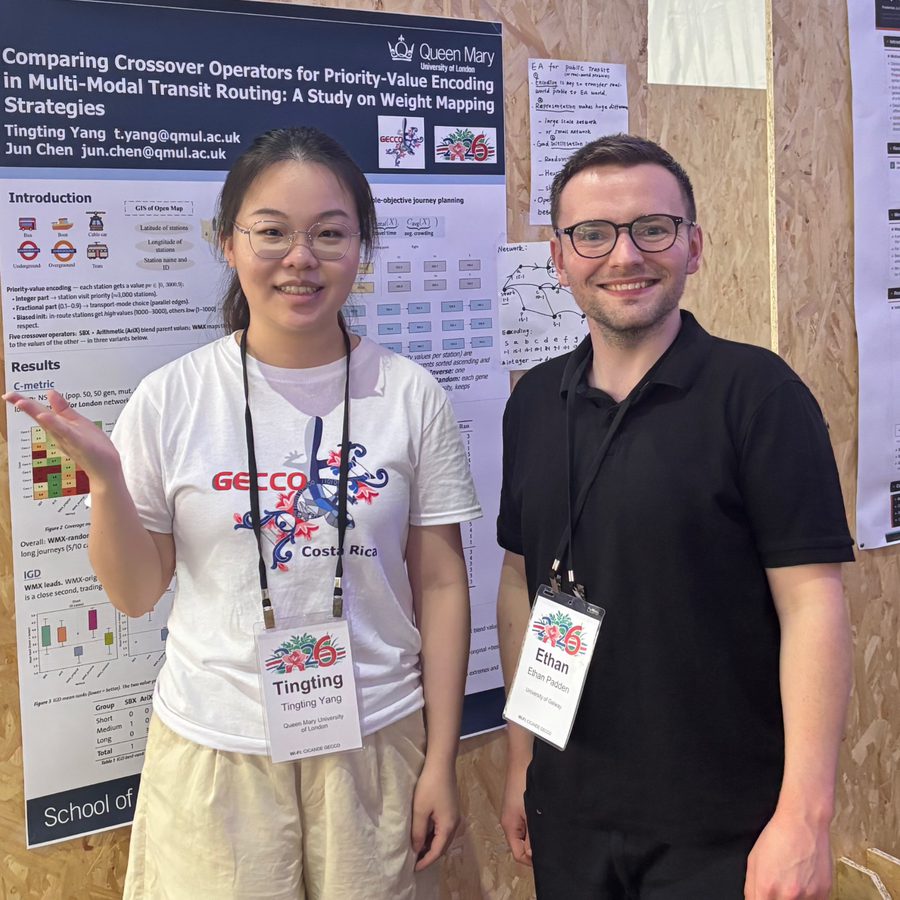
Two papers at ACM GECCO 2026 in San José, Costa Rica, with a conference travel grant.
Became Vice Chair of the IEEE QMUL Student Branch. The branch's first workshop of the year, on AI for research, ran with Women in AI UK, IEEE WIE UK & Ireland and IEEE ITSS. Report
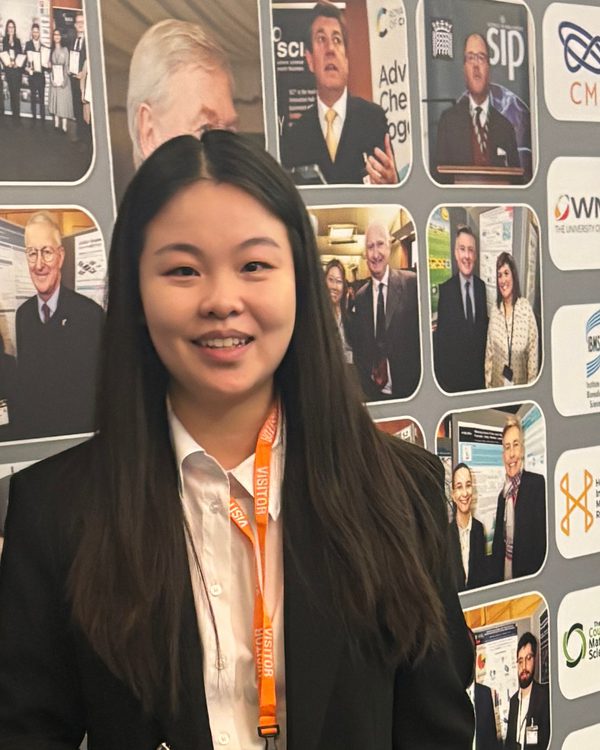
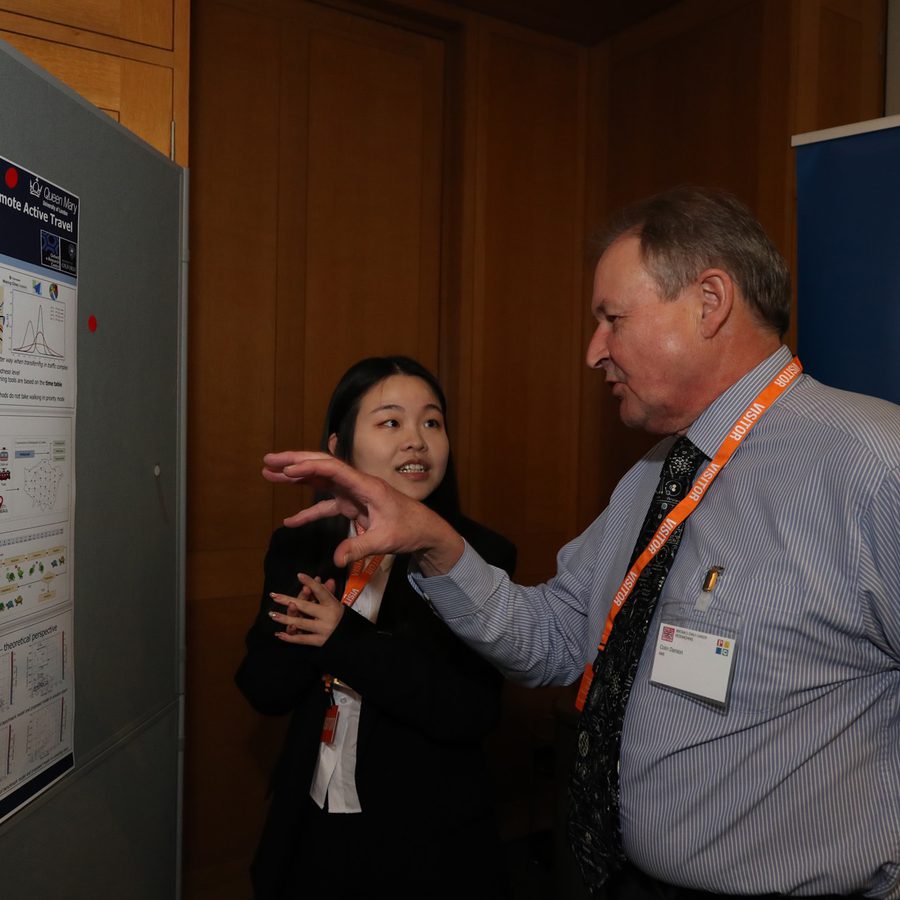
Presented “A public transit routing algorithm to promote active travel and mitigate crowding for future London” as a STEM for BRITAIN finalist at the Houses of Parliament (Mathematical Sciences). QMUL news
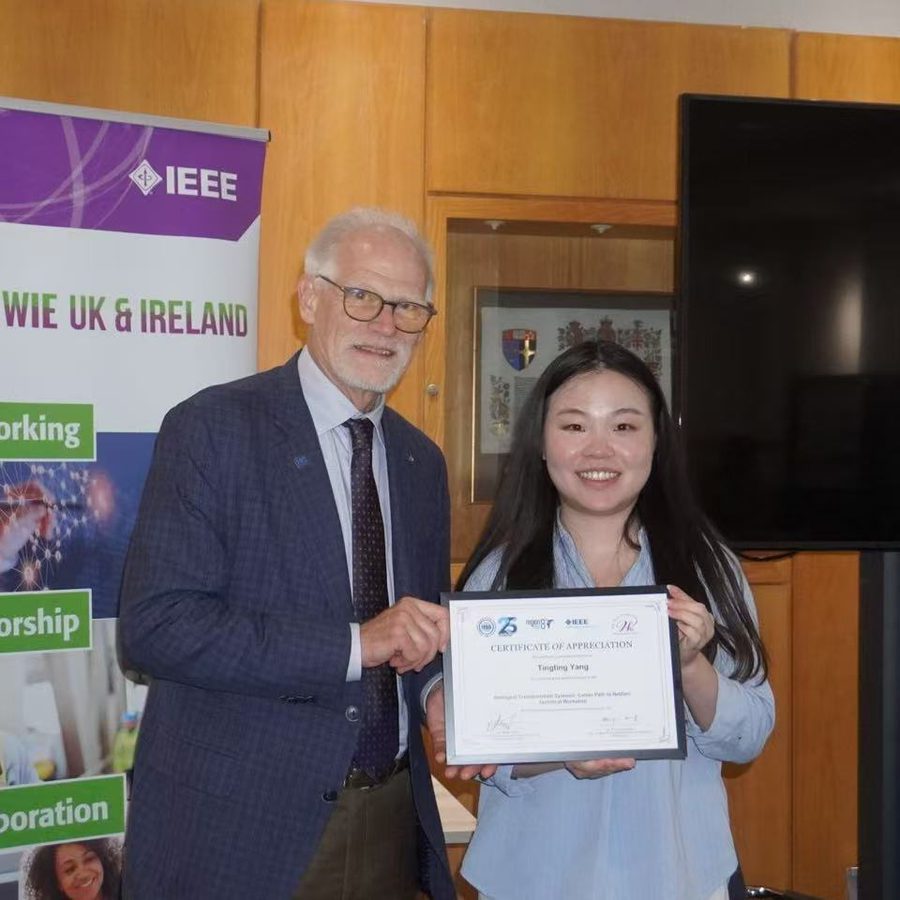
Won second prize for best poster, out of 11 entrants, at the IEEE workshop “Intelligent Transportation Systems: Career Path to NetZero”, and moderated its career panel. QMUL news
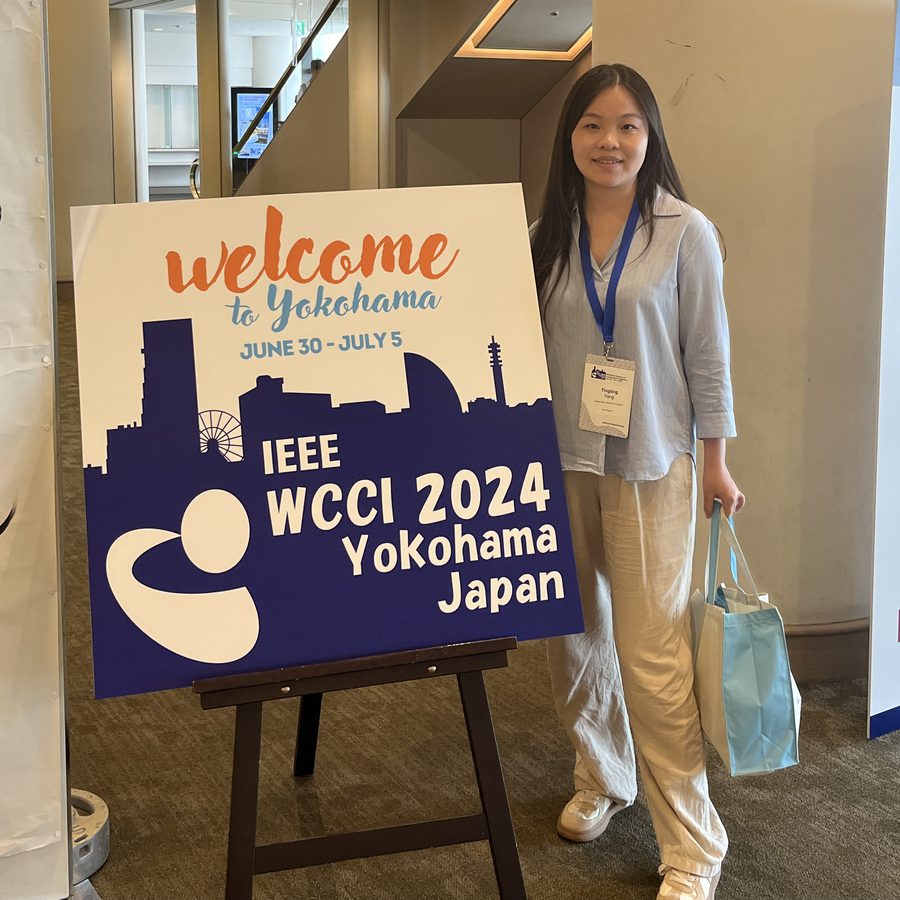
Driver stress prediction paper at IJCNN 2024, part of IEEE WCCI 2024 in Yokohama, Japan.
EventsPresenting the work
Jul 2026ACM GECCO 2026, San José, Costa RicaAt the poster on crossover operators for priority-value encoding in multi-modal transit routing.Mar 2025STEM for BRITAIN, Houses of ParliamentDiscussing crowding-aware routing for London as a finalist in Mathematical Sciences.Sep 2024IEEE workshop on Intelligent Transportation Systems, Queen MaryReceiving a certificate for moderating the career panel. My poster also won second prize.Jul 2024IEEE WCCI 2024, Yokohama, JapanFor the IJCNN paper on driver stress prediction with genetic programming and CNN-LSTM.
RecognitionHonours and grants
2026
Travel Grant, ACM GECCO 2026, San José, Costa Rica
2025
Finalist, STEM for BRITAIN (Mathematical Sciences), Houses of Parliament, London
2024
Best Poster, Second Prize (of 11), IEEE workshop on Intelligent Transportation Systems, sponsored by IEEE ITSS
2022
Summer Research Camps, The Chinese University of Hong Kong and Tsinghua-Berkeley Shenzhen Institute
2021
Outstanding Thesis Award (top 1%), Tianjin Normal University
Teaching & serviceBeyond research
Teaching assistant, QMUL (2024–2025)
Numerical Methods and Data Science in Engineering EMS506U
Computational and Mathematical Modelling EMS418U
Vehicles for the Future EMS603U
Outreach
Senior Student Ambassador, QMUL Student Recruitment and Widening Participation (2024–): study-skills workshops and careers events for pupils aged 15–16 and their families
Career panel moderator, IEEE Women in Engineering UK & Ireland workshop on intelligent transportation, London (2024)
Service
Vice Chair, IEEE QMUL Student Branch (2025–)
Reviewer, Scientific Programming (2022–2023)
Member of INFORMS, ACM, IEEE Computational Intelligence Society and IEEE Intelligent Transportation Systems Society
Other research roles
PhD AI researcher, QMUL Digital Environment Research Institute (2024): a searchable dashboard mapping AI expertise across the university's academic staff
Data scientist, QMUL Doctoral College (2024): interactive dashboards on interdisciplinarity across REF units
Research assistant, Hong Kong Metropolitan University (2023) and The Hong Kong Polytechnic University (2021–2023)
ContactGet in touch
I am happy to talk about positions, collaborations and invited talks. Email is the best way to reach me: t.yang@qmul.ac.uk.
School of Engineering and Materials Science, Queen Mary University of London, Mile End Road, London E1 4NS, United Kingdom